How Recording Artists Can Stand Out When AI Music Floods Streaming Platforms
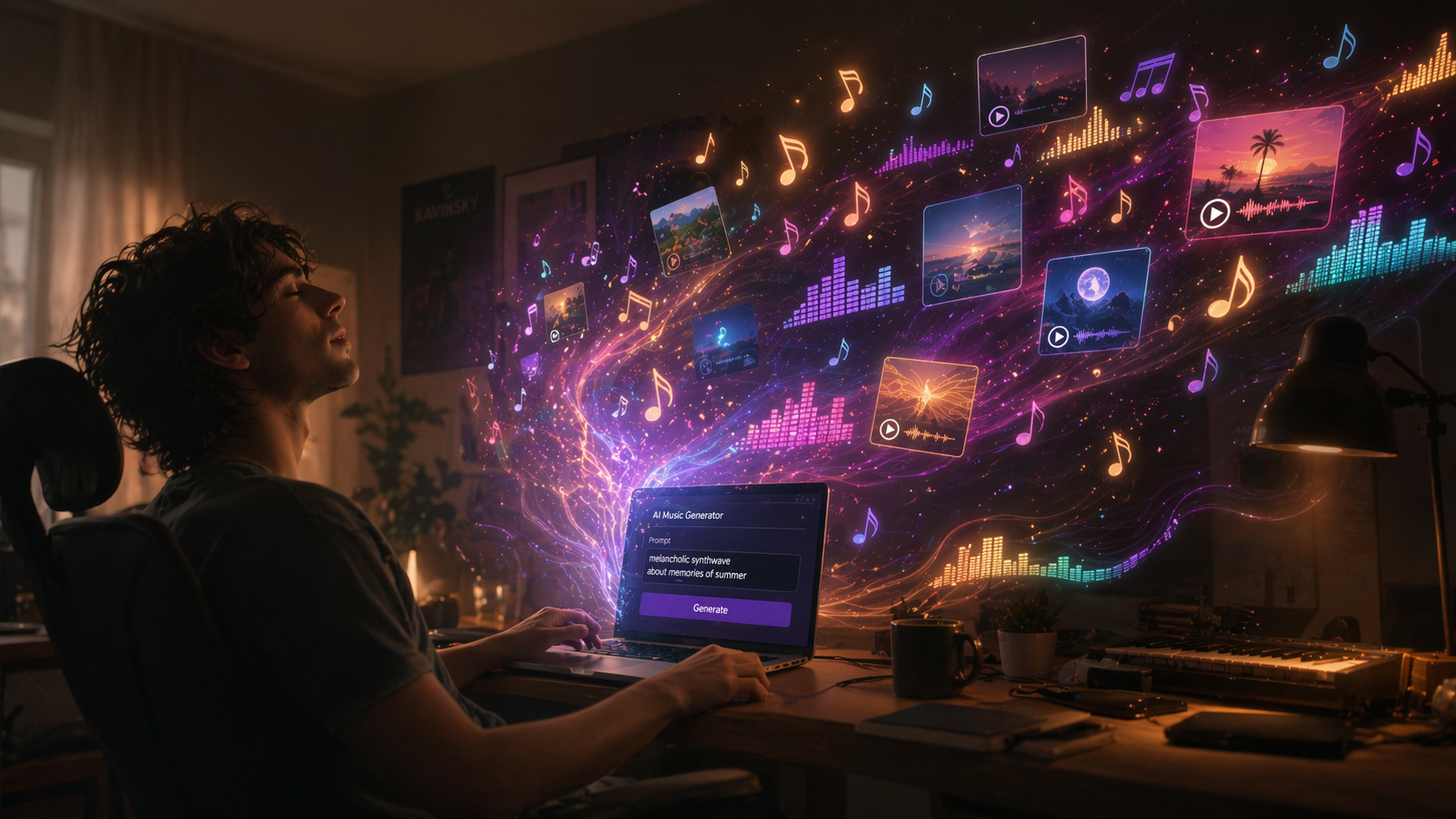
Man listening to music on his computer.
Recently, Deezer reported that nearly half of all new music uploaded to their platform is now AI-generated.
That number is hard to ignore.
We are now living in a time where tens of thousands of songs are being created and released every single day, generated in just seconds. The pace alone is enough to shift the way we think about recorded music. Add in the plague of fraudulent AI music into the equation, and the reality becomes mind-blowing.
But beyond the exploding volume of music, there is a more important question sitting underneath all of this:
What is this doing to value of music itself? What is the the long game here? How will REAL HUMAN ARTISTS stand out in a flood of AI generated music?
More Music, Less Meaning?
Music has never been easier to create.
The tools are faster. The barriers are lower. The output is constant.
But when creation becomes effortless, meaning becomes harder to find.
At some point, it stops feeling like music and starts to feel like throughput. Like something being produced rather than something being expressed.
And that shift is subtle, but it matters.
When Perfection Replaces Perspective
The moment I hear a song that’s AI generated, something changes in me.
It feels too perfect. Too resolved. It’s almost as if every edge has been smoothed out to the point where nothing is left to discover.
And the question that comes to mind is simple:
What does these AI songs mean to us? What does this music mean to anybody?
There was no shared experience behind it. No creative tension. No process that led to that result.
And without that connection, it’s difficult to feel anything about them at all.
Music Has Always Carried Something More
AI can generate sound with remarkable accuracy.
But music isn’t just about sound alone.
There is something deeper and more meaningful in a LIVE performance or a recording.
Something that goes beyond arrangement, tone, or production quality. Something that is felt more than explained.
It is the sense that a real person is behind the music. That something was lived, processed, and then expressed.
That kind of connection does not come from speed or optimization.
It comes from intention.
And in many ways, it comes from something spiritual. Something that cannot be manufactured, only revealed.
A Record Is Built on Decisions
With today’s tools, assembling a track has never been easier.
Layers can be stacked, parts can be generated, and a “finished” product can come together quickly.
But a record has never been defined by how many elements it contains.
“The record is not the sum of the tracks. It’s the result of decisions.”
Every meaningful record is shaped by thousands of choices.
What is allowed to remain. What is held back. What is emphasized. What is left untouched.
These decisions are not technical. They are human.
And that’s where meaning begins to take root.
The Moments You Cannot Manufacture
Over the years, I’ve found that some of the most powerful moments in a recording are the ones that were never planned.
They emerge unexpectedly. A miscue. A timing issue. A sound appearing where it wasn’t supposed to be.
And instead of correcting it, you stop and marvel at what this “happy accident” has revealed.
There is a well-known example of this in the song “Sailing” by Christopher Cross.
The now-iconic string intro was not originally intended. During a recording session, two 24-track tape machines fell out of sync while rewinding.
When playback resumed from the top, one machine entered in the middle of the song.
That’s when they heard the isolated string section coming in like a magical introduction.
What they heard in that moment was unexpected, but it worked!
So they kept it, and made it the official intro to the song.
That happy accident became one of the most defining moments of the entire record.
Moments like that cannot be engineered. They arrive unannounced.
And sometimes, it feels like something was given rather than created.
Why Perfection Isn’t the Goal
This is where the contrast becomes clear.
AI-generated music is designed to resolve toward correctness.
It draws from everything that exists and assembles it into something coherent, balanced, and often technically flawless.
But in doing so, it removes the possibility of interruption.
There are no accidents. No misfires. No moments that force a new direction.
And without those moments, something important is missing.
Music has never been about arriving at perfection.
It has always been about discovering something along the way.
The Weight Behind a Performance
I recently watched a performance by guitarist Jack Gardiner on Rick Beato’s YouTube channel that really stuck with me.
He was playing with such incredible speed and precision, moving effortlessly across the instrument.
It was so impressive on the surface.
But what made it resonate with me was not the execution alone.
It was the weight and sacrifice behind it.
Years of practice. Discipline. Failure. Growth.
All of that is present in a performance like that, whether the listener can articulated it or not.
And it raises an important question.
If AI can replicate the all of that, what is the point?
WHO are we supposed to respond to?
WHO is to be the recipient of our adoration
WHO gets the standing ovation?
The software coder?
WHAT ARE WE DOING!?
Why I Created #TunesbyHumans
This AI shift in music has not pushed me away from creating. If anything, it has pulled me deeper into it.
It led me to start a series called #TunesbyHumans.
The idea was simple, but intentional.
A mostly a-cappella music series where I sang and recorded every part myself, building each harmony note by note, chord by chord. No shortcuts. Just the process. Occasionally bringing other humans in on the track with some instrumentation
But there was another layer to it.
I intentionally chose songs from a different era, primarily from the 1970s and early 1980s.
That period carried a different kind of musical mindset.
There was a sense of artistic integrity. A commitment to songwriting. A depth in chord structure. A focus on groove, collaboration, and musical identity.
But more than anything, there was intention.
Songs were not just written. They were lived. There was always a reason they existed.
And that became an important part of the series.
With each video, I shared a piece of the story behind the song. Not just how it sounded, but why it was written. What drove it into existence.
Because that context matters.
When you understand the “why” behind the song, the music takes on a different weight.
And that is something I believe we are in danger of losing.
This Isn’t About Being the Best. It’s About Being Real
Making music has never been about being the most advanced or the most efficient.
It has always been about being honest.
About creating something that comes from a real place.
Something shaped by experience, thought, and feeling.
That is what people connect with, even if they cannot explain it.
The Opportunity in This Moment
There is an opportunity here for artists who are paying attention.
As music becomes easier to generate, the value of intention increases.
Not because it is rare, but because it is recognizable.
Listeners may not always be able to describe what they are hearing.
But they can feel the difference.
Don’t Lose What Matters
AI is not going away.
But it can’t replace the reason music exists in the first place.
That still comes from people.
From effort. From experience. From something deeper that cannot be assembled or generated.
So the question becomes:
Are we just creating music to keep up?
Or are we creating music because something in us needs to be expressed and shared?
The answer to that question will define everything going forward.
About the Author
Darren Rust is the owner of Skyland Studios in Lakeville, MN, working with artists locally and remotely on recording, mixing, and mastering.
His work focuses on mix clarity, balance, and helping artists bring out the best in their performances.
If you’re working on an album or a song, and you need mixing and mastering,
you can learn more or book a session here:https://www.skylandstudio.com/book-mixing-mastering-skyland